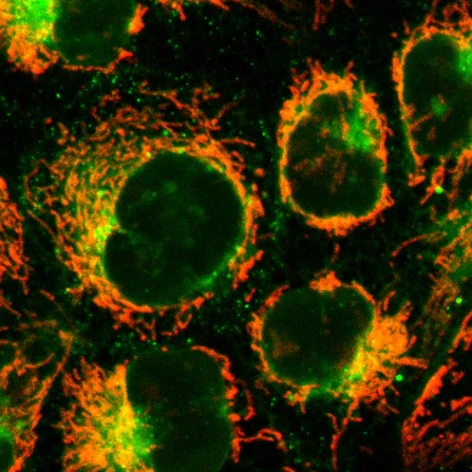
A new discovery from IOCB Prague makes it easier to see what is happening inside cells
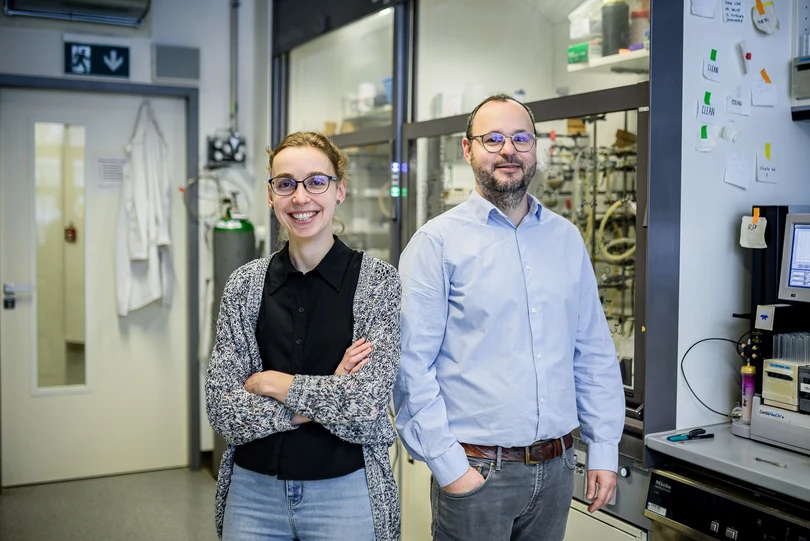
Thanks to a recent study by researchers at IOCB Prague, it is now possible to monitor processes in living cells more effectively than before, including responses to drugs or changes in cellular structures. The researchers have developed a new type of fluorescent labels guaranteeing higher-contrast and clearer images via fluorescence microscopy. The discovery is important for medicine and the pharmaceutical industry, among other areas. The team led by Milan Vrábel and Tomáš Slanina of IOCB Prague collaborated on the research with the chemical biology group of Péter Kele from Hungary.
The newly developed fluorescent labels are visible only when they bind exactly where intended, i.e. to the target molecule. As a result, cells no longer need to be repeatedly washed in solution to remove excess fluorescent dye, which reduces costs. Under current conditions, dyes often bind where they are not needed, complicating observation and rendering the process more expensive. Everything effectively fluoresces, making it very difficult to capture the specific location of interest.
The researchers succeeded in creating fluorescent labels that provide a clear picture of cellular processes using fluorogenic triazinium probes. Triazinium salts reliably suppress unwanted fluorescence. A cell labeled with the developed probe therefore does not fluoresce and becomes fluorescent at a selected site only after a specific chemical reaction occurs. In such cases, researchers see only what they actually intend to observe.
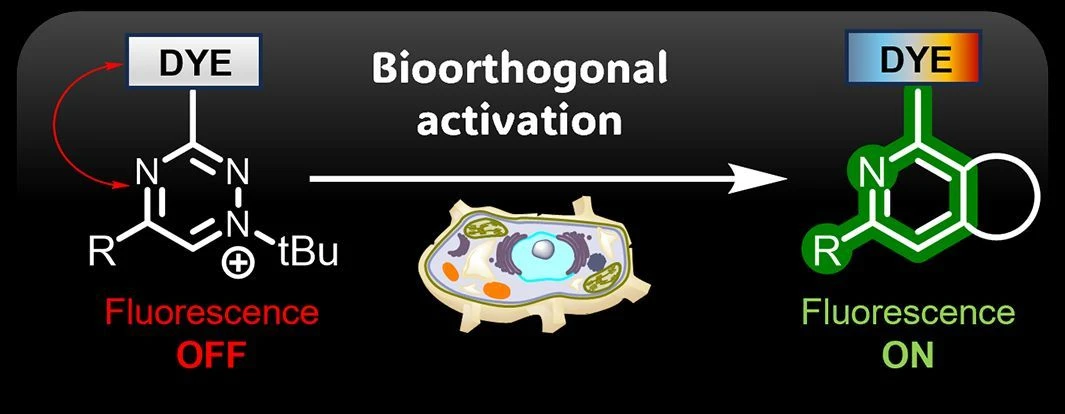
“A significant advantage of the new technology is its versatility,” explains the first author of the study, IOCB Prague postdoctoral researcher Veronika Šlachtová, adding: “Our method works across the visible spectrum, from blue to far red. Thanks to labels of different colors, we can monitor several cellular structures within a single experiment at the same time.” The probes can also be prepared relatively easily, making them potentially suitable for future commercial availability.
Fluorescence microscopy is widely used in modern biology, medicine, and the pharmaceutical industry. The method makes it possible to observe processes inside cells, such as protein movement, drug effects, or changes in cellular structures. The technology is also suitable for studying carbohydrate structures on the cell surface, which play a role in immune responses, infections, and cancer metastasis.
“High-quality and reliable fluorescent labeling facilitates everyday work in the laboratory while also providing higher-quality data. In the long term, it may accelerate drug testing or enable more precise monitoring of molecular processes in cells,” says the corresponding author of the study, Dr. Milan Vrábel of IOCB Prague. Thanks to the combination of high sensitivity, ease of preparation, and a broad color spectrum, the new method has the potential to become part of the routine practice of many research laboratories.
Original article
- Šlachtová, V.; Bím, D.; Németh, K.; Barańska, E.; Bellová, S.; Dračínský, M.; Dzijak, R.; Kele, P.; Slanina, T.; Vrabel, M. Fluorescence Quenching Properties and Bioimaging Applications of Readily Accessible Blue to Far-Red Fluorogenic Triazinium Salts. J. Am. Chem. Soc. 2026, 148 (1), 1183–1196. https://doi.org/10.1021/jacs.5c17428