


Science excursions for schools in English (Week of the Czech Academy of Sciences)
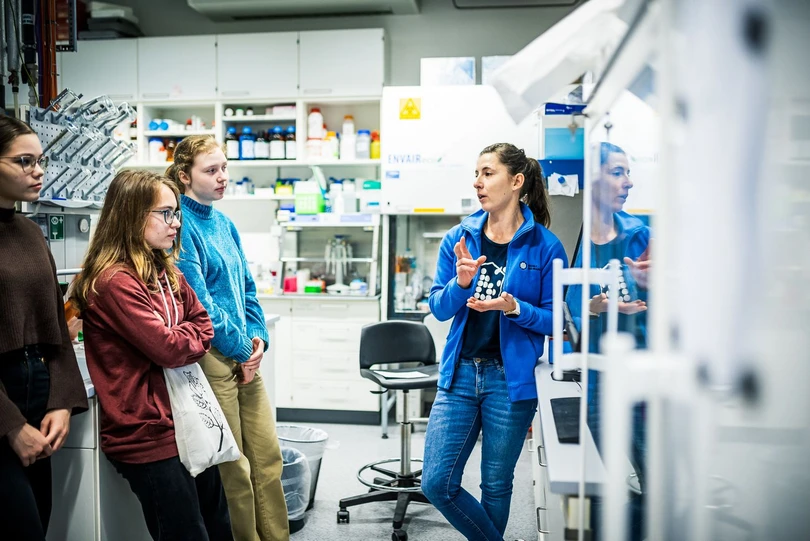
As part of the Week of the Czech Academy of Sciences at IOCB, we are offering guided excursions of our scientific labs for school classes (for students aged 13+) in English.
School groups are invited to visit our laboratories on Friday, November 6, from 9 a.m. to 12 p.m.
See the list of available excursions and register your class below.
If you are interested in our school program conducted in Czech, please go here, for general program in Czech here.
Organization & Registration
Excursions are intended for students from the 8th grade of elementary school and the 3rd grade of 8-year high schools.
For safety and practical reasons, each group is limited to 13 people, including a teacher. If you plan to come with a larger group of students, please divide them into smaller groups and book a separate program for each. The groups can then rotate to ensure everyone experiences the same presentation
You can book the program for your class here from 14 October after 3 p.m.
Program
Epidemic Paralyzes Prague
A mysterious epidemic has struck Prague. Where did the new virus come from, how is it spreading, and can we stop it before it is too late? Join our scientific team and follow the investigation from the first reported cases and identification of the virus to discovering its weak points and developing an effective inhibitor. Together, we will explore how research on dangerous viruses works in practice and how modern virology, chemistry, and structural biology can contribute to the development of new antiviral drugs.
Fluorescence in Action – Seeing Drug Development
Fluorescence is the ability of molecules to emit colored light. This phenomenon often accompanies scientists in their first steps toward developing new drugs, which often target enzymes – molecular machines that catalyze chemical reactions in living organisms. In our laboratory, you can see how we use fluorescence to purify enzymes and test potential drugs.
From Rings to the Lab: A New Life for Diamonds at the Nanoscale
Forget sparkling jewelry in shop windows. In laboratories today, we work with diamonds that you cannot see with the naked eye. These so-called nanodiamonds are a thousand times smaller than a human hair and, at first glance, resemble ordinary black dust. In reality, however, they hold a revolutionary tool for modern science and healthcare. In our presentation, we will reveal how these miniature crystals act as tireless spies in the microworld. You will see how they can penetrate directly into living cells, serve as incredibly precise thermometers, monitor complex biological processes, and help us detect cancer early. Come find out how nanotechnology enables us to better understand the human body and why diamond is one of the most promising materials for 21st-century medicine.
Invisible World Under the Microscope
A vast, unseen universe exists just beyond the limits of human vision. Microscopes serve as windows into this hidden cosmos, revealing that the fundamental building blocks of life and matter are not only functionally complex, but breathtakingly beautiful. This exhibition invites visitors to step into the microscopic realm and experience the profound intersection of art and science. We will show the mesmerizing patterns, vibrant colors, and intricate architectures of both biological specimens and everyday materials. From the glowing, delicate scaffolding of living cells to the alien landscapes of crystalline structures, attendees will see firsthand how nature's greatest masterpieces are often invisible to the naked eye.
Measure the Mass of DNA or Protein
How do you weigh biomolecules that are invisible to the naked eye? In our service laboratory, we’ll not only show and explain how it’s done – you’ll even get to try the analysis yourself, using instruments you won’t find anywhere else.
NMR and EPR – spies in the world of molecules
When we think of magnetic resonance, we might picture the equipment doctors use to image the human body. Nevertheless, the same technique is used by chemists to reveal the structure of unknown substances, showing how individual atoms are linked by bonds and what their spatial arrangement is. In our Nuclear Magnetic Resonance (NMR) and Electron Paramagnetic Resonance (EPR) lab, we’ll explain how the magnetic properties of nuclei and electrons help us investigate molecular structures. You’ll also see our equipment, the powerful superconducting magnet we use, which has a magnetic field 100,000 times stronger than the Earth's. We will explain how molecules communicate with us using their magnetic field and what they are willing to tell us about their structure.
Steroid hacks: unlock the brain app
When steroids are mentioned, most of us picture muscular athletes. Doctors, on the other hand, think of anti-inflammatory drugs. But here’s the plot twist: steroids are actually our body’s own “super apps”, running quietly in the background and influencing almost everything we do. They’ve been with us from the very beginning – when our parents met, when we were born, throughout our growth – and they’ll still be around when we’re old and wise. Steroids don’t just influence our body; they hack our brain, our mood, and even our vibe and behavior.
Right now, science is learning how to use these “fast-acting brain apps” to treat depression, epilepsy, autism, and Down syndrome. In this talk, you’ll see why steroids are far more than a fitness cliché – they’re one of biology’s most underrated superpowers.
Through the Looking-Glass: The Curious World of Chiral Molecules
Would the food on the other side of the mirror be safe to eat? Inspired by Lewis Carroll’s Through the Looking-Glass, this talk explores the fascinating world of molecular chirality. From the sugars and amino acids essential to life, to medicines and helicene molecules that interact with light, we will discover how seemingly identical mirror-image molecules can behave very differently. Join Alice on a journey from the chemistry of life to the surprising optical properties of chiral molecules.
Unknown DNA
When we say DNA, most of us will probably imagine a nice double-helix and think about genes. However, DNA can display also other less traditional functions. These are in the scope of our lab’s interest, and we consider them interesting enough to spread their fame publicly. During our session, we will show you how we find such short specific DNA sequences able to trigger a chemical reaction. Moreover, you will prepare some of the reactions with your own hands and observe their progression using several techniques which we routinely use in our research.
Unveiling the Secrets of Matter
Ever wonder how fireworks get their colors? Want to see argon plasma hotter than the surface of the Sun? Curious to verify if your ring is really gold? In our lab, we use plasma and light to determine the elemental composition of samples. After exciting the sample with X-rays or heat, it emits characteristic radiation, which tells us about the presence and quantity of each element. Come take a look and delve into the mysteries of analytical chemistry!