Structural sensitivity without chirality: Observation of magnetic Raman optical activity outside resonance
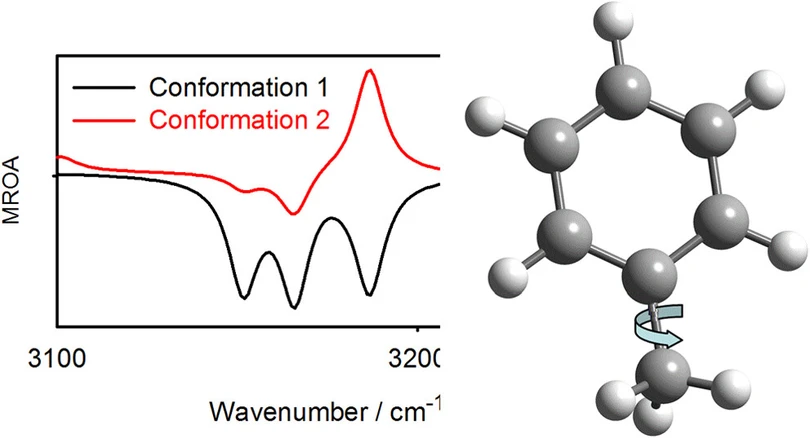
Moumita Das and Petr Bouř from IOCB Prague have demonstrated in a recent paper in the Journal of the American Chemical Society (JACS) that far-from-resonance magnetic Raman optical activity (MROA) is measurable for a wide variety of molecules and that its sensitivity does not depend on intrinsic molecular chirality. This discovery makes MROA a distinctive analytical method with potential applications in probing the conformational behavior of both chiral and achiral molecules in solution and other liquid systems.
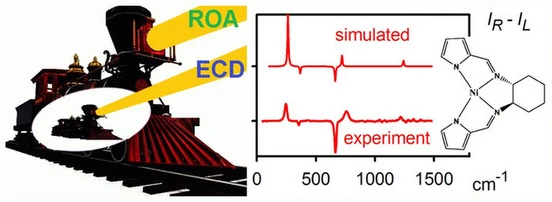
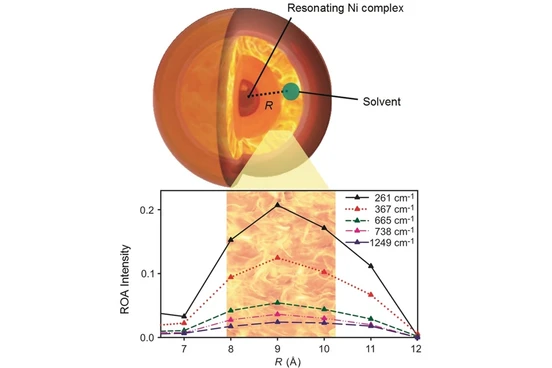
Magnetic Raman optical activity (MROA) is traditionally associated with systems fulfilling resonance conditions, i.e., those absorbing the excitation radiation. Its presence in far-from-resonance (FFR) regimes, where absorption is negligible, has not been previously reported.
In a recent study, Moumita Das and Petr Bouř from IOCB Prague identified MROA signals under FFR conditions in a range of common organic molecules. This observation challenges the established understanding of the phenomenon and suggests that MROA is more general than previously assumed.
The authors developed a theoretical description of the effect and implemented a computational protocol for simulating MROA intensities. The predicted spectral features show reasonable agreement with experimental data and reproduce observed trends.
The results further indicate that MROA spectra are sensitive not only to molecular identity but also to conformational changes. Researchers also detected this structural sensitivity in solution even when molecules lacked intrinsic chirality.
These findings position MROA as a potentially valuable analytical tool for conformational studies of both chiral and achiral molecules in liquids, with implications for spectroscopy and structural chemistry.
Read the paper
- Das, M.; Bouř, P. Structural Sensitivity without Chirality: Observation of Magnetic Raman Optical Activity outside Resonance. J. Am. Chem. Soc. 2026, 148 (10), 11058–11067. https://doi.org/10.1021/jacs.5c22470