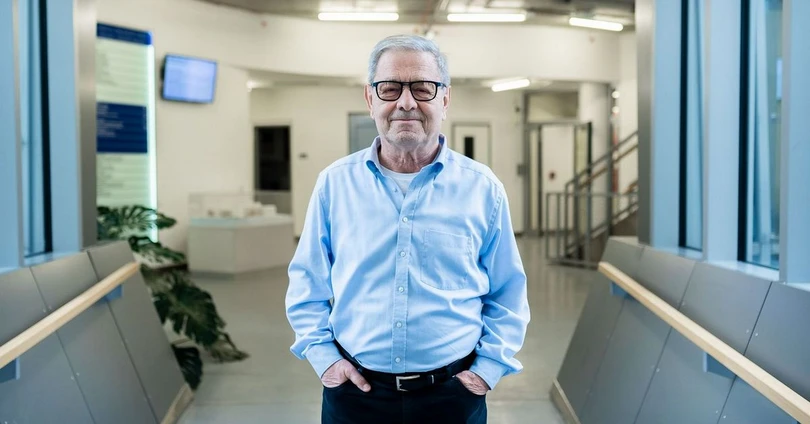
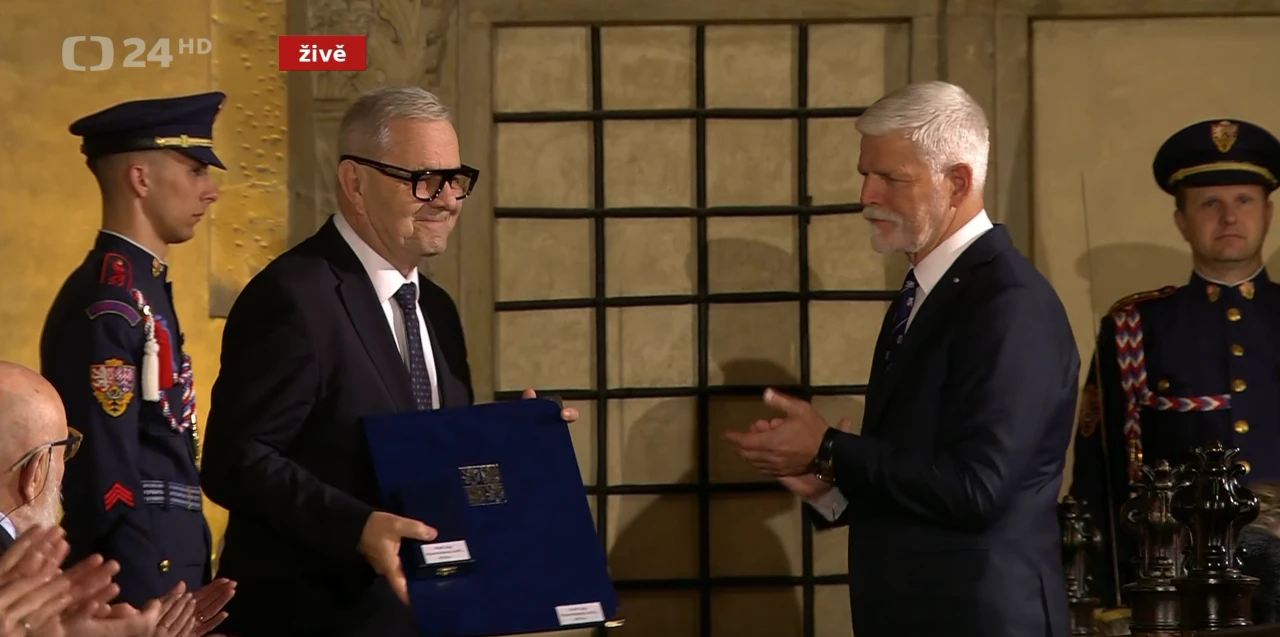
Pavel Hobza, a theoretical chemist at IOCB Prague, has been awarded the Medal of Merit, a Czech state honor, by President Petr Pavel. Hobza is one of the most highly cited Czech scientists and specializes in noncovalent interactions. His research has helped to formulate the definition of the hydrogen bond and explain the forces that determine the structure and properties of biological macromolecules.
Professor Pavel Hobza specializes in computational and theoretical chemistry. Among his most important discoveries is the prediction of the improper hydrogen bond. When this interaction forms, the covalent bond between hydrogen and the atom to which it is attached vibrates at a higher frequency. This is known as a blue shift, as opposed to the expected red shift.
Experimental confirmation of the improper hydrogen bond helped pave the way for a new definition of hydrogen bonding. Adopted by the International Union of Pure and Applied Chemistry (IUPAC), this definition is now widely accepted by chemists worldwide. “I didn’t rewrite the textbooks, as the media often say, but it was a major achievement, particularly because it started with a theoretical prediction,” Hobza explains.
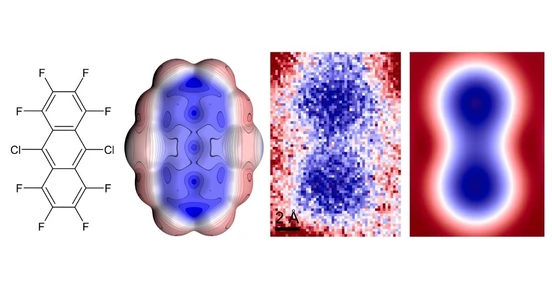
He has also significantly contributed to real observation of σ-holes: regions of depleted electron density on halogen atoms covalently bound to carbon that give rise to another important type of noncovalent interaction, halogen bonding. Theoretical calculations predicted the existence of the σ-hole toward the end of the twentieth century. Less than twenty years later, Hobza and his team participated in its experimental detection.
World-class research under communist rule
Hobza’s interest in chemistry began with a high school teacher in Olomouc. His fascination with molecules initially drew him to nuclear physics, but he soon realized that his interests lay elsewhere. In his third year at university, he joined Rudolf Zahradník’s group at the J. Heyrovský Institute of Physical Chemistry. Zahradník would later become president of the Czech Academy of Sciences. Under his supervision, Hobza completed his master’s thesis and subsequently his Candidate of Sciences dissertation, the equivalent of a PhD dissertation, which he defended in 1974.
He was then forced to leave the Academy of Sciences for political reasons. After a long search, he found a position at the Institute of Hygiene and Epidemiology, now the National Institute of Public Health. Zahradník remained at the Academy but was banned from teaching and supervising students. The two nevertheless continued to work closely together on noncovalent interactions, making pioneering studies in this field.
A new beginning at IOCB Prague
After the Velvet Revolution of 1989, Hobza returned to the J. Heyrovský Institute of Physical Chemistry, where he worked for more than a decade. In 2003, following disagreements with the institute’s management, his group of twenty researchers moved to IOCB Prague with the support of its director at the time, Zdenek Havlas. “Zdenek Havlas made a very bold decision. The institute treated us exceptionally well, and I believe we have more than repaid that support,” Hobza says.
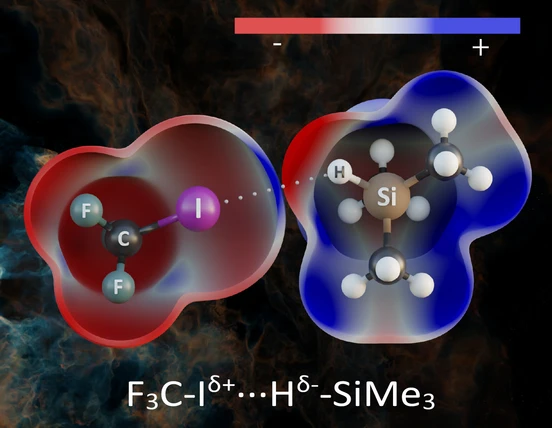
His team is now studying hydrogen bonds involving negatively charged, or hydridic, hydrogen and proposing a further revision to the definition of hydrogen bonding. “Every study teaches us something new. We keep adding pieces to the puzzle, and we hope to have enough evidence to support our theory soon. We find great joy in it – science and discovery are wonderful,” he says.
Hobza’s work has earned him numerous honors, including the Czech Head Award (2008), the Schrödinger Medal (2017), and the Neuron Award for Lifetime Contribution to Science in Chemistry (2022).
He turned eighty in October 2026 and continues to lead his research group at IOCB Prague. He is still looking forward to new discoveries. “There is no greater pleasure than doing creative work that you enjoy and find fulfilling,” he says.