Deoxyribozymes, tools for precision sensing and machine learning-guided discoveries
Deoxyribozymes represent a new frontier in biotechnology. They show that DNA is much more than a storage molecule for genetic information: it can also function as a catalytic machine. Unlike traditional enzymes made of proteins, such DNA-based tools are stable, easy to produce in large quantities, and can be evolved in a lab to perform different chemical tasks we need. Their potential is vast, ranging from low-cost diagnostic kits to high-speed screening tools that can facilitate drug discovery. As our ability to understand and predict their behavior continues to improve, these versatile molecules are becoming a cornerstone for future personalized medicine and environmental monitoring.
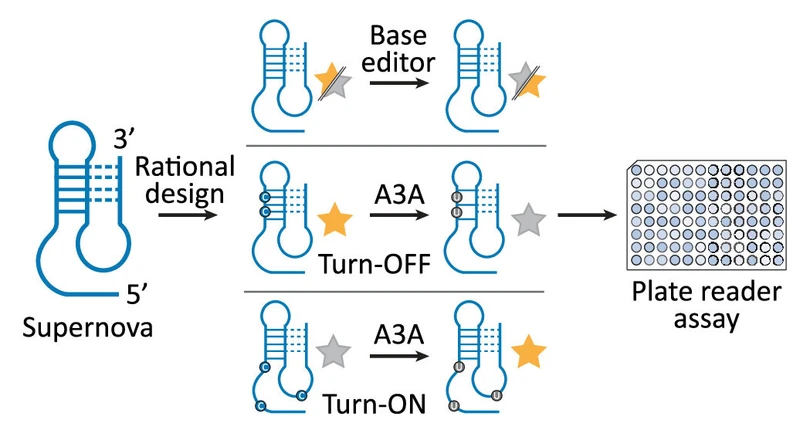
Researchers led by Edward Curtis from IOCB Prague have developed a remarkable DNA molecule called Supernova that acts as a tiny biological flashlight, glowing blue during a specific chemical reaction. By tweaking its sequence, scientists transformed Supernova into a sensor capable of detecting DNA-editing enzymes, which are proteins that alter the sequence of DNA and are often linked to the development of cancer. These new sensors represent a step forward because they are roughly three times faster and over five times cheaper than standard assays. Depending on how they are designed, these sensors can be either "turned off" or "turned on" by a DNA-editing enzyme in a sample. Such sensors will make characterization of DNA-editing enzymes easier, and could also help scientists to find new inhibitors.
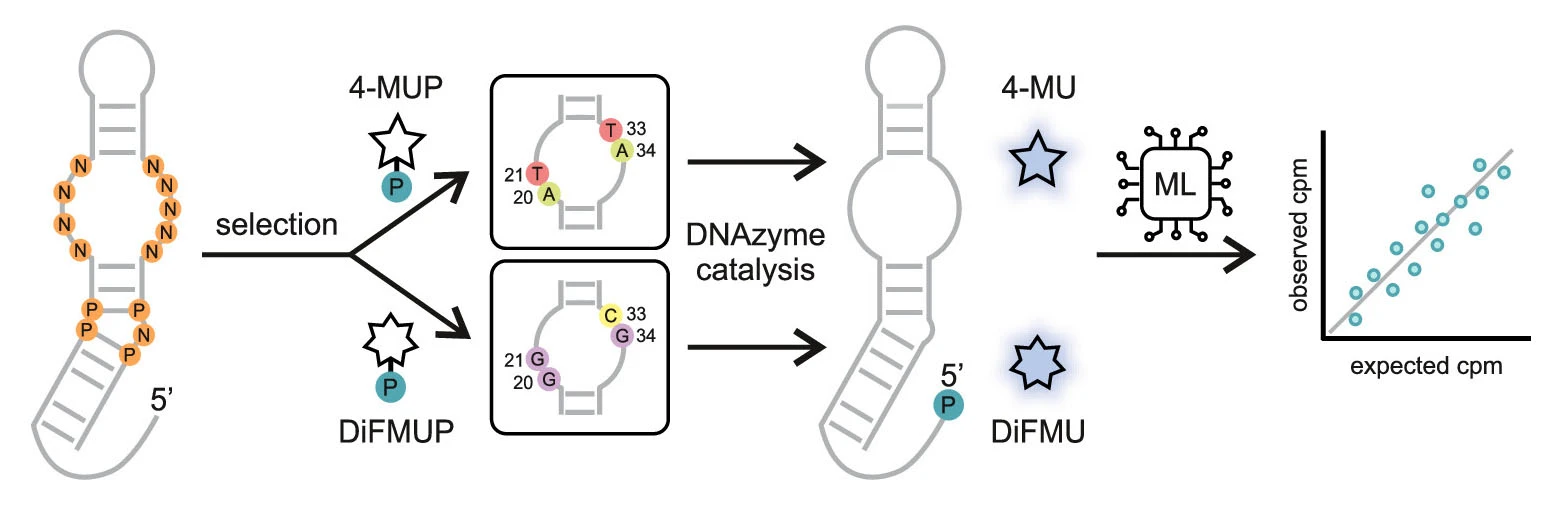
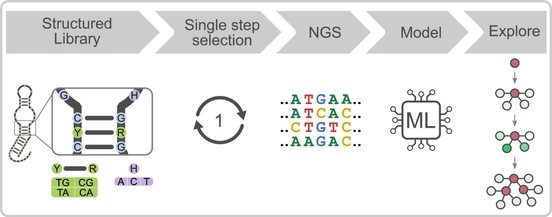
In another advance, researchers in the Curtis Group used a fluorescent deoxyribozyme named Aurora to explore how these molecular tools can be taught to recognize specific chemical targets. Using a combination of artificial evolution and machine learning, the team successfully identified specific mutations that change Aurora’s preference for one substrate over another. Machine learning is particularly powerful here because it allows researchers to predict how millions of different DNA variants will behave without having to test each one individually in a lab. This approach helps us understand the fundamental rules of how DNA molecules interact with the world, which is essential for designing more precise medicines and diagnostic tools.
These results are described in two recent publications:
- Jakubec, M.; Svoboda, M.; Kurfürst, J.; Svehlova, K.; Veverka, V.; Curtis, E. A. Chemiluminescent Deoxyribozyme Sensors for DNA-Editing Enzymes. ACS Chem. Biol. 2026. http://doi.org/10.1021/acschembio.5c00927
- Král’ová, Z.; Isler, L.; Volek, M.; Jandová, M.; Kurfürst, J.; Curtis, E. A. Probing the Specificity of Fluorescent Deoxyribozymes Using Single-Step Selections and Machine Learning. ACS Chem. Biol. 2026. http://doi.org/10.1021/acschembio.5c00969