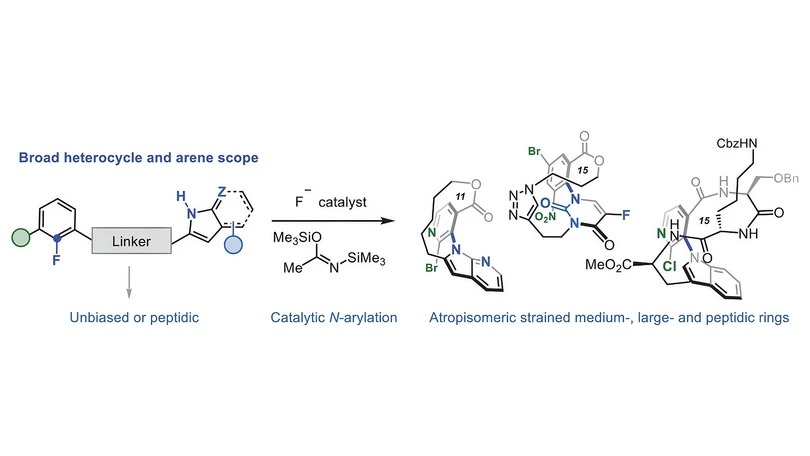
Researchers led by Paulo Paioti from IOCB Prague have developed a new catalytic macrocyclization strategy for synthesis of cyclic molecules that are difficult to obtain by conventional methods. The approach enables the direct formation of sterically hindered carbon–nitrogen bonds through an intramolecular nucleophilic aromatic substitution (SNAr) reaction and provides access to highly strained atropisomeric macrocycles, medium-sized rings and atropopeptides.
The key innovation lies in the way the reaction generates and regenerates a strong base. In many base-catalyzed substitution reactions, catalyst turnover is inefficient because the leaving group is not sufficiently basic. The new method avoids this limitation through use of a fluoride catalyst in combination with an organosilane, described by the authors as a base-embedding electrophile, allowing the active base to be regenerated through a different catalyst turnover mechanism. Such and other mechanistic aspects have been studied experimentally and computationally with Daniel Bím from UCT Prague.
The method makes it possible to construct strained medium-sized rings and macrocycles directly from linear precursors with a N-heterocycle head and an aryl fluoride tail. Many of the resulting compounds have three-dimensional shapes and stereochemistry that are of particular interest in medicinal chemistry.

The researchers applied the reaction to direct cyclization of tryptophan-containing peptides. This enabled the synthesis of structurally and stereochemically diverse atropopeptides inspired by naturally occurring ribosomally synthesized and post-translationally modified peptides (RiPPs), known as RiPPs. Preparation of these cyclic peptides will enable bioactivity screenings in search of compounds with anticancer and antibacterial properties. Such studies will also shed light on the impact of atropisomerism on the molecules’ pharmacological properties.
Read the paper
- Abbasi Kejani, A.; Dey, P.; Stillman, N. H.; Andrade, D. M.; Šimek, M.; Dračínský, M.; Bím, D.; Paioti, P. H. S. Synthesis of Large- and Medium-Sized Heterobiaryl Atropisomeric Rings and Atropopeptides by Catalytic Intramolecular SNAr. Angew. Chem. Int. Ed. 2026, e8290035. https://doi.org/10.1002/anie.8290035