Accurately predicting NMR chemical shifts remains difficult for protons that can exchange with their environment in solution. These protons are covalently bound to electronegative atoms in hydroxyl (-OH), amine (-NH), and thiol (-SH) group. Their NMR signals are highly sensitive to hydrogen bonding, interactions with the solvent, and the continuous motion of molecules. Conventional DFT calculations typically treat the solvent in a simplified manner, often overlooking important interactions between dissolved molecules and their surroundings. A new computational approach developed by scientists led by Martin Dračínský from IOCB Prague addresses this problem by combining machine-learning (ML) molecular dynamics (MD) with ShiftML3, a machine-learning model for rapid prediction of NMR shielding.
The method first uses ML-based molecular dynamics to generate realistic ensemble of molecular structures in solution, capturing the constantly changing hydrogen-bonding patterns. ShiftML3 then predicts the chemical shifts for each configuration within fractions of a second. Although the model was originally developed for molecular solids, it also performs remarkably well in solutions. In molecular crystals, molecules are surrounded by close neighbors and experience a wide variety of intermolecular contacts, many of which closely resemble the interactions found in liquids.
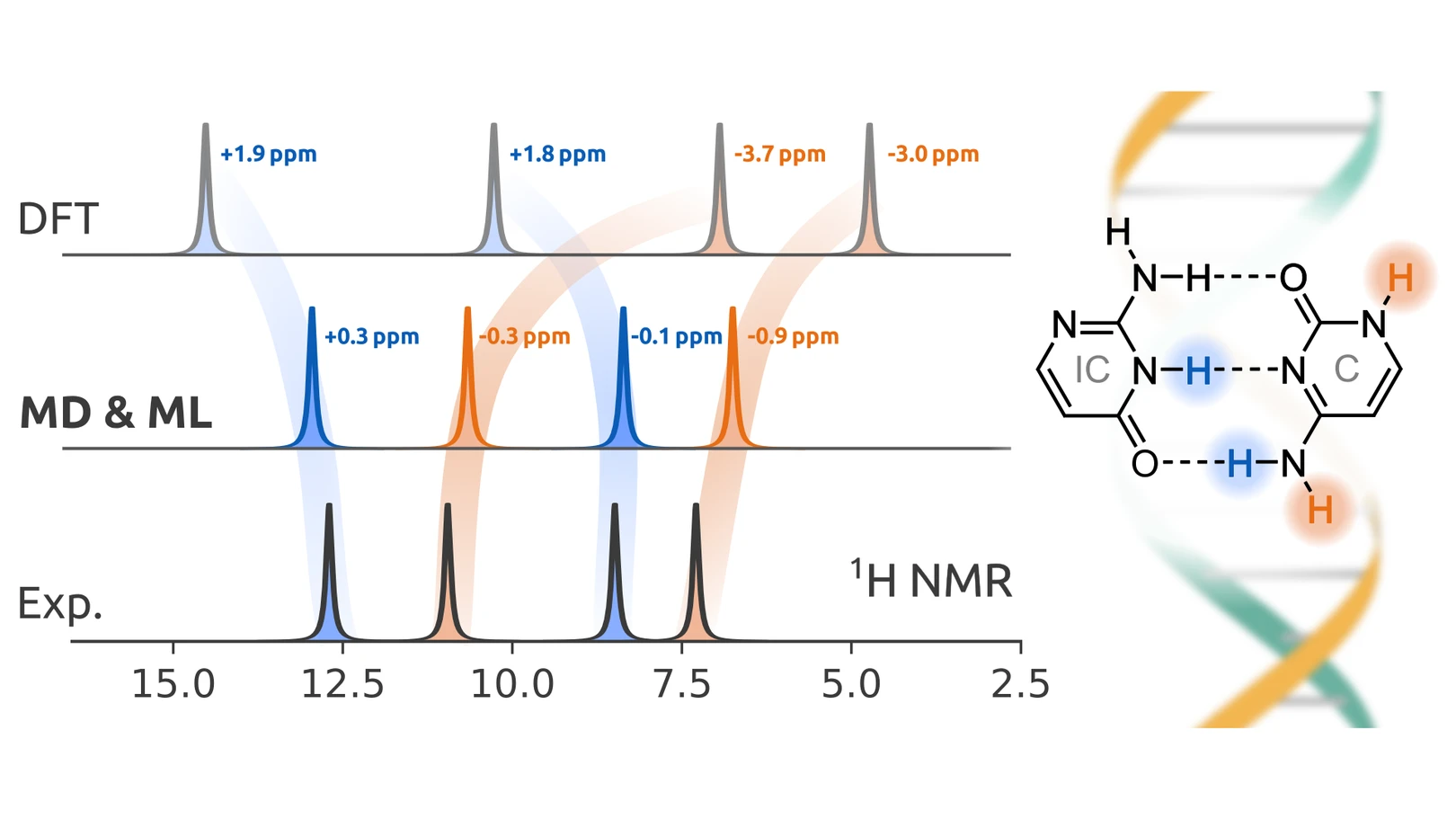
- Socha, O.; Pavlišová, J.; Manna, D.; et al. Quantitative Prediction of Exchangeable Proton Chemical Shifts. Nat. Commun. 2026, 17, 8842. https://doi.org/10.1038/s41467-026-75743-w