Researchers led by Hana Cahová from IOCB Prague have discovered a previously unknown type of chemical modification at the 5′ end of RNA molecules in human cells. The finding expands our understanding of RNA processing and may show new links between RNA metabolism and cellular stress.
RNA molecules can carry chemical structures known as caps at their 5′ end. These caps affect RNA stability, processing and function. While the best-known example is the 7-methylguanosine (m⁷G) cap found on most eukaryotic messenger RNAs, recent studies have revealed a growing number of so-called non-canonical caps.
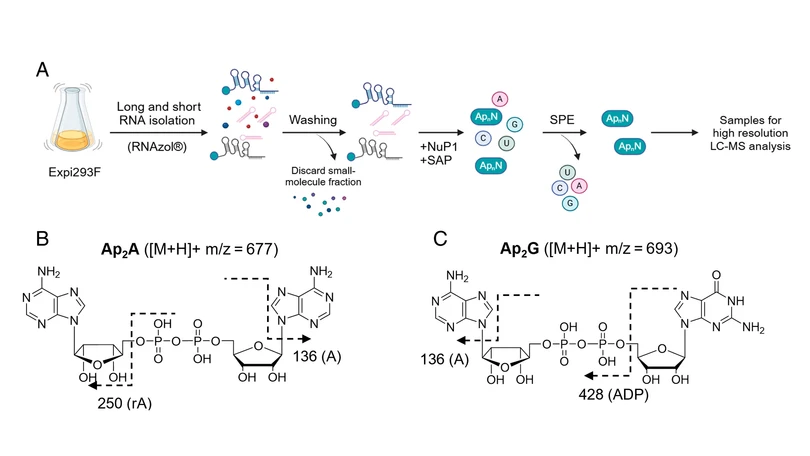
In the new study, researchers identified dinucleoside diphosphates, specifically diadenosine diphosphate (Ap2A) and adenosine guanosine diphosphate (Ap2G), attached to RNA in human cells. Using liquid chromatography–mass spectrometry (LC–MS), they were able to detect and quantify these Ap2N-capped RNAs. Interestingly, the amount of Ap2N-capped RNA increased when cells were exposed to oxidative stress, suggesting that these structures may be connected to cellular stress responses.
To determine what types of RNA carry the new caps, the team developed a sequencing method called Ap2N-RNA Seq. The technique selectively captures Ap2N-capped RNAs and allows them to be identified by sequencing. The strongest candidates were transfer RNAs (tRNAs) and fragments derived from them. In addition to full-length tRNAs carrying Ap2G caps, the researchers identified previously uncharacterized 3′ tRNA fragments consistent with an Ap2A cap at their 5′ end. These fragments appear to originate from a specialized subset of tRNAs rather than simply from the most abundant tRNAs in the cell, suggesting that they may have specific biological functions that remain to be discovered.
The discovery adds another layer to the growing complexity of RNA biology. The newly developed Ap2N-RNA Seq method will make it possible to investigate how these RNA molecules are formed, processed and degraded, and what roles they may play in cellular physiology. By identifying both a new class of RNA caps and a method for studying them, the work opens a new avenue for exploring the diverse chemistry of the RNA life cycles.
Read the paper
- Vopalensky, P.; Nešuta, O.; Mititelu, M.; Škríba, A.; Spampinato, A.; Viktorinová, K.; Buchová, Z.; Březinová, J.; Reyes-Gutierrez, P. E.; Lukšan, O.; Cahova, H. Detection and Sequencing of Ap2N-Capped RNAs in Human Cells. Proc. Natl. Acad. Sci. U.S.A. 2026, 123 (38), e2608168123. https://doi.org/10.1073/pnas.2608168123